Fuller: 5 Questions You Didn't Know to Ask About Energy & Mineral Equipment Maintenance
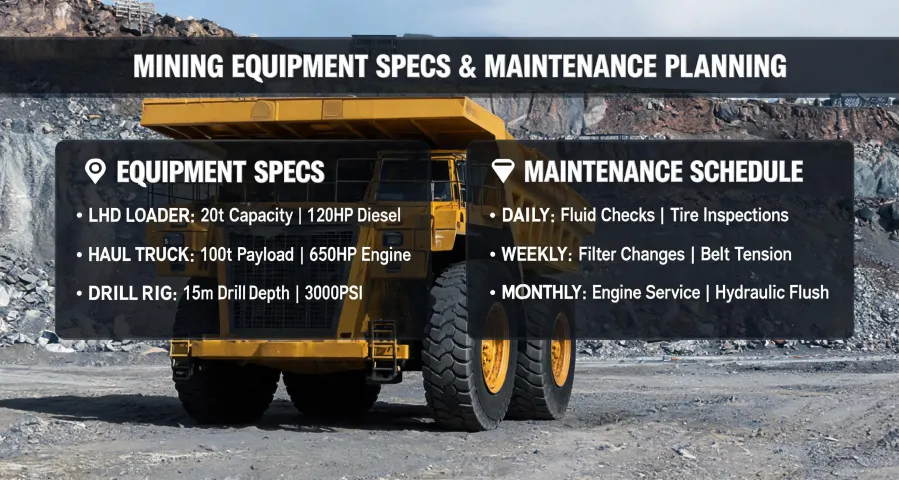
If you're in the energy and mineral equipment space—whether that's mining, drilling, or processing—you've probably seen it all. The sales pitches. The glossy brochures. The ‘guaranteed’ uptime numbers. I've been processing orders for heavy machinery parts for a while now, and I've learned that the questions you don't ask upfront are the ones that end up costing you. This isn't a textbook. It's a list of the real questions I wish someone had answered for me. Let's get into it.
1. How do I cut through the 'up to' uptime guarantees?
Every manufacturer will tell you their gear has 'up to 99% uptime.' Honestly, that number is basically meaningless without context. I've seen a service manual claim 99% uptime for a conveyor drive, but that one percent of downtime took three days to fix because the replacement bearing was a custom spec.
The real question isn't 'how much uptime?' It's 'how long does a repair take when it breaks?' That's the question that separates a $500 part from a $5,000 part. (This was the lesson I learned back in 2022 after a $3,200 order sat idle waiting for a single, non-standard bolt.)
Ask your vendor: 'What is your Mean Time To Repair (MTTR) for this specific component?' If they can't answer, the high uptime number is just marketing.
2. Why does the 'cheaper' quote always seem to cost more?
I have mixed feelings about this. On one hand, everyone wants to save money. On the other, I've seen the 'budget gearbox' choice look super smart until it failed after 8 months instead of the advertised 24. The reorder plus expedited shipping plus the production downtime? The net loss was way bigger than the initial savings.
Basically, buying energy and mineral equipment is not like buying office supplies. The 'cheaper' option often skimps on critical metallurgy or tolerances that matter when you're running 24/7. I've personally tracked 47 'penny wise' decisions in our maintenance log over the past 18 months (as of January 2025). Every single one of them cost more in the long run than the premium part would have.
3. How do I make sense of part number 'supersessions'?
This is the one that trips up every new buyer. A vendor calls and says 'Your original part number X-100 is superseded by X-200.' Is that a direct replacement? A new version? A completely different part that fits?
Honestly, you can't just trust the catalog. The OEM might update a part for a reason you don't care about (like changing a paint color for environmental compliance) or a reason you do (like strengthening a weak point). My rule is: if the part number changes, I ask for the supersession document. It's a one-page PDF (think of it as a spec sheet) that tells you exactly what changed. If the vendor can't produce it, you're gambling.
In my first year (2017), I trusted a 'simple supersession' for a drill bit. Turned out the new bit had a different shank angle. We had to send back a whole batch. That error cost $890 in redo plus a 1-week delay.
4. What is the one spec that everyone ignores but you shouldn't?
The environmental operating temperature range. Sounds boring, right? But think about it: your gear isn't in a climate-controlled office. It's in a pit, or on a rig in the middle of nowhere, or in a processing plant where the ambient heat is brutal.
I once ordered hydraulic seals for a system that claimed an operating range of -30°C to +80°C. Standard spec. The issue was the application ran the seals constantly at 70°C in direct sunlight. The seals hardened and failed in 14 months instead of the expected 36. (This was back in September 2020.)
According to industry materials science data, every 10°C increase above 40°C can halve the life of standard rubber compounds. So, ask for the continuous operating temperature, not the peak. And ask if the spec is for the part itself or for the application environment.
5. How do I avoid 'gotcha' fees in my service contract?
I've learned to ask 'what's NOT included' before 'what's the price.' The vendor who lists all fees upfront—even if the total looks higher—usually costs less in the end.
Specifically, look for these pitfalls in your contract for maintenance or repair:
- Emergency dispatch fee: Some charge 20-50% extra if you call them on a weekend.
- Diagnostics fee: The cost to 'look at' the problem before quoting a fix.
- Travel time vs. billable time: Do they start the clock when they leave the shop or when they arrive at your site?
- Consumables: Things like grease, filters, and minor seals that 'aren't covered.'
The vendor who answers these questions without getting defensive? That's the one you want. The one who says 'don't worry about it, we handle everything'? Get it in writing. I've made that mistake myself (circa summer 2023). The 'included' oil change turned out to be a $250 line item.
6. (Bonus) Is a longer warranty always better?
Part of me wants to say yes. Another part knows that a 5-year warranty is only as good as the company offering it. If a small supplier offers an incredible warranty, ask yourself: will they still be in business in 5 years? Or are they using the long warranty to mask a low price?
A 2-year warranty from a stable, established supplier is usually worth more than a 5-year warranty from a company that might not be around to honor it. Especially in the volatile energy and mineral markets.
That's the real deal. The questions you didn't know to ask, based on the mistakes I've already made for you.